R.W. TIDErwtide.com

A novel by R.W. Tide

The Acoustic
Shadow

He came aboard to count fish,
not investigate a death.

A research vessel. A missing record.
A storm that leaves nowhere to go.

Available now

MARITIME SUSPENSE · THE ACOUSTIC SHADOW

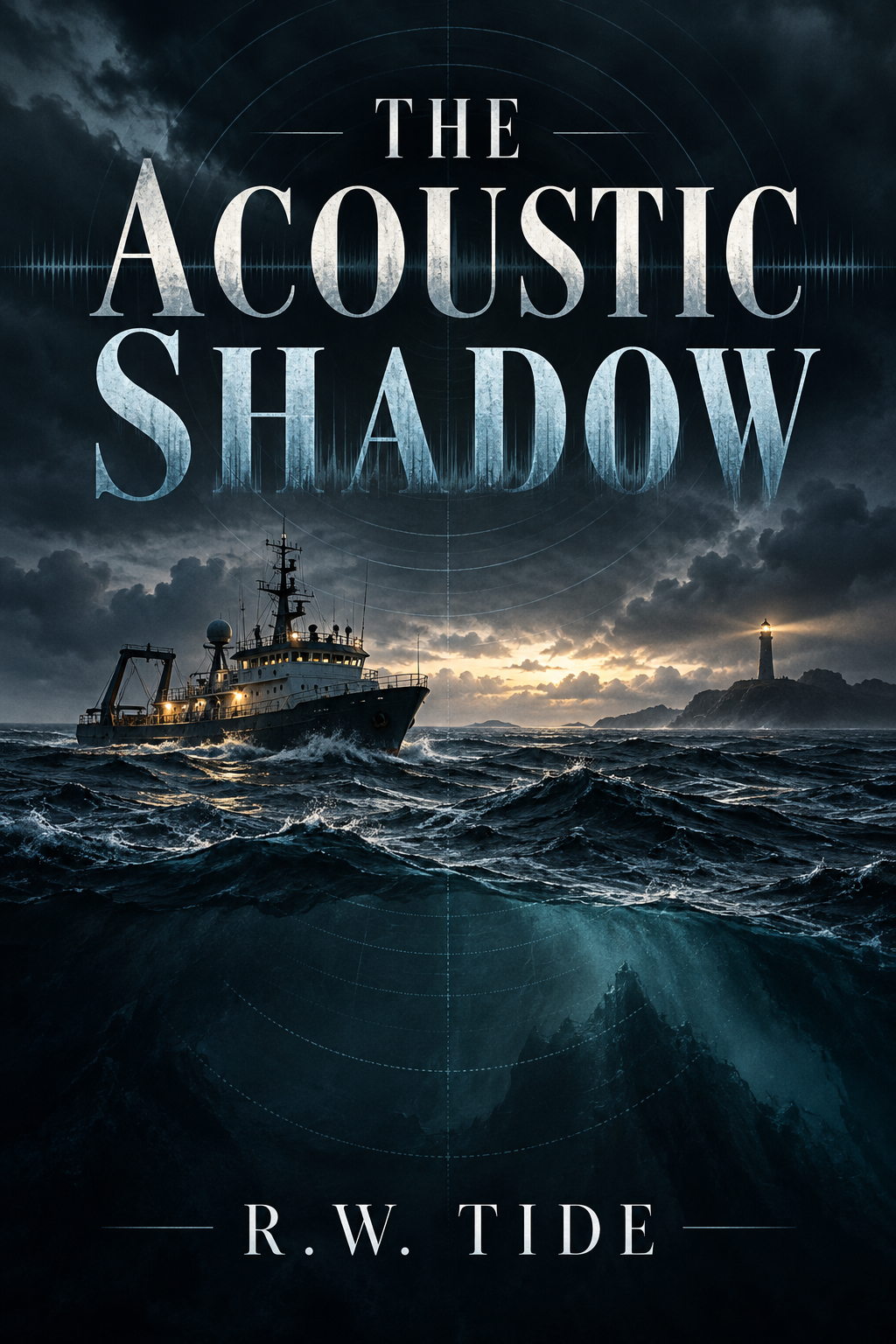
The Acoustic Shadow by R.W. Tide. Cover showing a research ship beneath storm clouds, with sonar rings and a dark sea.
There’s more beneath the surface

01 / Aboard Meridian

A new posting.
Familiar instincts.

Marcus Finch expected quieter work aboard the research vessel Meridian. Then he finds a scientist dead in the wet lab.

An electrical accident seems the simplest explanation. But research records are missing, accounts don’t quite fit, and the former naval investigator finds himself asking questions he thought he’d left behind.

As a nor’easter closes around the ship, questions of trust become questions of survival.

ContinueThe science beneath the story

02 / Eyes on the seafloor

How do you count
what you can’t see?

Lower a camera. Bring a hidden world into view.

Illustration of a drop-camera surveyA cable lowers a metal frame carrying a camera and lights. The camera views scallops on the seabed. SURVEY / OPTICALCAMERA FRAMEFIELD OF VIEWSEABED OBSERVATIONS → POPULATION ESTIMATES
Conceptual illustration · equipment and scale simplified

For a scallop survey, the seafloor itself is the evidence. Images let researchers observe animals and habitat, then use those observations to estimate what lives across a much larger area.

It’s patient work: returning to survey stations, examining images, and turning individual observations into a picture of a fishery.

Real science / SMAST

A closer look, with UMass Dartmouth

The School for Marine Science & Technology’s Marine Fisheries Field Research Group has conducted cooperative drop-camera surveys with the commercial scallop industry since 1999. Its survey work includes Georges Bank and the Mid-Atlantic scallop grounds.

Explore SMAST’s research
ContinueLife aboard a research ship

03 / The working ship

A floating laboratory.
A very small world.

Science at sea depends on people who do very different jobs, in very close quarters.

An imagined fisheries research vesselSide profile of a research ship, with a bridge toward the bow, laboratories amidships, and a working deck and lifting frame aft. 01 / BRIDGE02 / LABORATORIES03 / WORKING DECK
An imagined vessel profile · not a plan of a real NOAA ship
01

Keep the ship moving

Navigation, engineering, and deck operations make the science possible. The ship is both a workplace and a home.

02

Bring the ocean aboard

Samples and instrument records turn ocean conditions into evidence that scientists can study.

03

Work beyond the rail

Survey equipment connects a moving ship to the water and seafloor beneath it.

Meridian is fictional. The work has real counterparts: the University of Delaware’s R/V Hugh R. Sharp supported NOAA’s Atlantic sea scallop dredge survey from 2008 to 2023.

Explore the real scallop survey
ContinueExplore the Gulf of Maine

04 / The Gulf of Maine

The sea has
a long memory.

Beneath the water is a landscape shaped by ice.

The Gulf of Maine’s glaciated seafloor holds exposed bedrock, gravel, and areas of finer sediment. What looks like an unbroken surface from the ship conceals a varied landscape below.

That physical ground matters to the living world above it. Understanding habitat begins with understanding what’s underfoot—even when it’s out of sight.

Explore it ashore

The coast is closer than you think.

You don’t need a research vessel to start exploring. Discover the rocky shore and tide pools at Odiorne Point in New Hampshire, or explore the coastal ledges at Two Lights State Park in Maine.

Odiorne Point · Rye, NH

Start with Seacoast Science Center’s guide to the tide pools just outside its doors.

Explore Odiorne’s tide pools Visit Seacoast Science Center

Two Lights · Cape Elizabeth, ME

Explore the rocky coast, then look closer with the Maine Geological Survey’s guide to the area.

Visit Two Lights State Park Read the local geology guide

Background contours are illustrative, not a navigation or bathymetric chart.

ContinueReturn to the book
The Acoustic Shadow book cover

The Acoustic Shadow / R.W. Tide

Your next voyage
starts here.

Compromised loyalties. Valuable science.
And a storm closing in.

Buy on Amazon

Available now on Amazon.

ContinueMeet R.W. Tide

About the author

R.W. Tide writes maritime suspense rooted in the working world of science at sea.
The instruments are precise. People are more complicated.

The Acoustic Shadow

Your next voyage.

Purchase links haven’t been added yet. Check back here for retailer details.